
The CDC estimates that foodborne illnesses affect 48 million people in the U.S. each year, and many of those cases start in food service settings.
Kitchens without a proper commercial kitchen cleaning schedule can face health inspection violations, grease fires, and outbreaks of foodborne illnesses. A cleaning schedule outlines which staff member is responsible for cleaning, when to do it, and how to confirm that the staff member has completed it.
This guide will show you how to create a cleaning schedule for a commercial kitchen that covers daily to quarterly tasks, plus it includes a free printable template that’s ready to use.
Key Takeaways
- A commercial kitchen cleaning schedule assigns every task a frequency (daily, weekly, monthly, quarterly), a zone, a responsible role, and a sign-off.
- Build the schedule in three steps: map zones, assign frequencies, and assign roles. Use a Master Cleaning Schedule (MCS) format for audit-ready documentation.
- Hood and exhaust cleaning follows NFPA 96. The 2025 update now requires digital documentation of every cleaning event.
Cleaning Schedule vs. Cleaning Checklist: What’s the Difference?
A checklist shows the tasks you need to complete. A schedule organizes those tasks by frequency, assigns specific cleaning responsibilities to named staff members, and includes time slots and sign-off fields for each task.
A checklist without a schedule leads to ad hoc cleaning. A schedule without a checklist produces tasks with no clear standard. You need both.
If you want the full list of tasks, check our commercial kitchen cleaning checklist.
How to Build a Commercial Kitchen Cleaning Schedule from Scratch
A working schedule comes together in three steps.
Step 1. Map Your Kitchen Zones
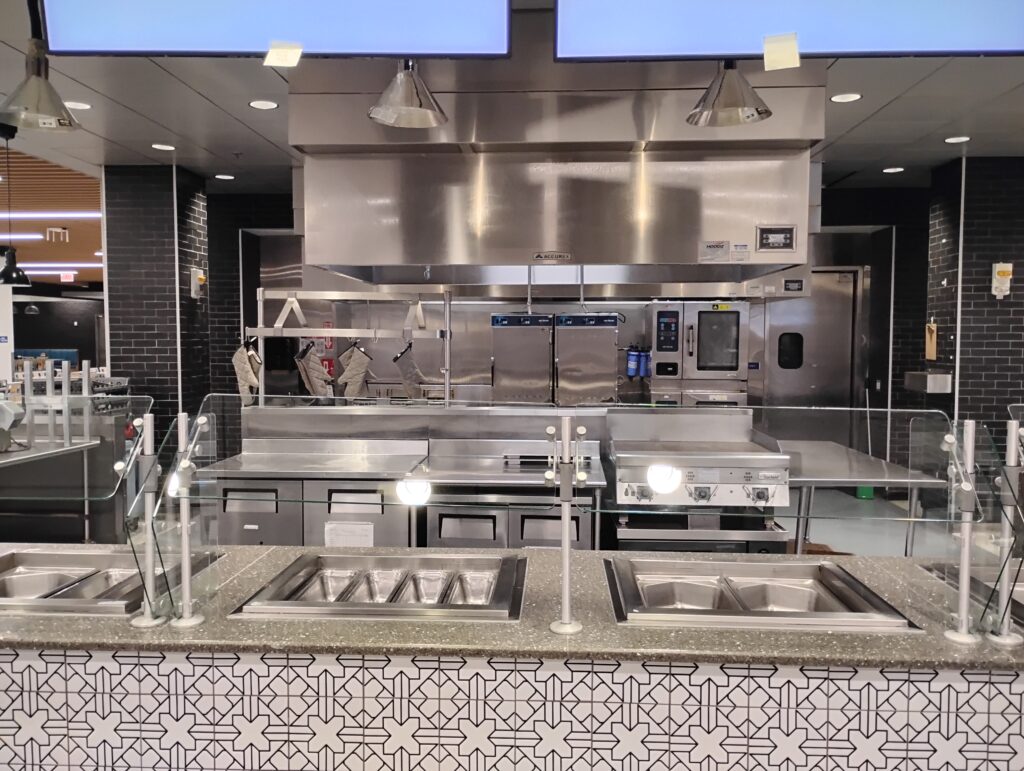
Organize your cleaning schedule by area instead of by task. A zone-based cleaning plan assigns a clear owner to each area and a recurring cleaning cycle.
Standard zones in a commercial kitchen schedule:
- Prep stations
- Cooking line (hot side)
- Cold side and refrigeration
- Dishwashing and three-compartment sink area
- Floors and drains
- Dry and cold storage
- Ventilation and exhaust systems
Mapping zones helps assign staff easily. Your line cook takes care of the hot side. Your prep cook handles prep. Your kitchen porter manages the floors and drains.
Step 2. Assign a Cleaning Frequency to Every Task
Every task falls into one of four tiers. This is the frequency-based structure of a professional Master Cleaning Schedule (MCS):
- After each use or during service: food contact surfaces, cutting boards, utensils
- Daily (shift-end): floors, equipment surfaces, trash, sink sanitation
- Weekly: deep clean cooking equipment, shelving, storage areas
- Monthly: behind appliances, freezer defrost, staff-accessible vent hoods, pest traps
- Quarterly or annually: hood and exhaust cleaning, refrigerator coils, deep drain descaling, and specialist deep cleans
Assigning these frequencies first ensures you don’t mark everything as daily or put off less frequent tasks until they become a problem.
Step 3. Assign Every Task to a Role and a Day
Assign every task to a specific role, not just “someone.” This reduces staff confusion and accountability gaps by clearly defining who cleans what and when. Give each weekly or monthly task a set day.
Here are two important rules:
- Schedule weekly deep cleans on your slowest service day. Avoid planning a three-hour hotline deep clean on a Friday night.
- Spread monthly tasks over four weeks. Don’t pile them all on the last day.
Every task needs a sign-off from the staff member who completed it and a review from the kitchen manager. A schedule without sign-offs is just a suggestion, not a compliance document.
Assign tasks to positions, not individuals, so there is coverage when someone is absent.
Use the sample below as a starting point. Change the days and roles to fit your operation:
Sample: Commercial Kitchen Weekly Deep Cleaning Schedule
| Day | Zone | Task | Responsible Role |
| Monday | Cold side | Wipe down walk-in cooler interior; organize shelves | Prep cook |
| Monday | Dishwashing | Descale and sanitize the dishwasher | Kitchen porter |
| Tuesday | Cooking line | Degrease the char-broiler and fryer surround | Line cook |
| Wednesday | Prep stations | Deep clean prep tables, reseat boards | Prep cook |
| Thursday | Storage | Rotate dry goods, clean shelving | Kitchen porter |
| Friday | Floors/drains | Deep clean floor drains, scrub baseboards | Kitchen porter |
| Saturday | Restrooms | Deep clean and restock | Kitchen porter |
| Sunday | Rest | Light spot clean only | All staff |
This is an illustrative example, not a universal template.
Commercial Kitchen Cleaning Frequency Reference
Use this table to create or audit your schedule. For the task-by-task breakdown, pair it with the commercial kitchen cleaning checklist.
| Task Category | Frequency | Responsible Role |
| Sanitize food prep surfaces and contact points | After each use | Line cook/prep cook |
| Clean and sanitize cooking equipment surfaces | Daily (shift-end) | Line cook |
| Mop floors; sanitize floor drains | Daily (shift-end) | Kitchen porter |
| Clean and sanitize sinks | Daily (shift-end) | Kitchen porter |
| Complete and sign the daily cleaning log | Daily (shift-end) | Kitchen manager |
| Deep clean cooking equipment and hot line | Weekly | Line cook |
| Clean behind and under all equipment | Weekly | Kitchen porter |
| Inspect and service the grease trap | Varies by volume; typically monthly to quarterly | Grease trap technician |
| Deep clean refrigeration interiors | Monthly | Prep cook |
| Clean walls, ceilings, and ventilation fans | Monthly | Kitchen porter |
| File monthly compliance logs | Monthly | Food safety manager |
| Hood and exhaust cleaning (NFPA 96 schedule) | Monthly to annually | Hood cleaning technician |
| Refrigerator coil cleaning | Semi-annually | Commercial cleaning contractor |
Grease trap and hood frequencies above are minimums. Your local Authority Having Jurisdiction (AHJ) may require more frequent service. The FDA Food Code provides the national framework, but your local health department enforces the inspection schedule.
Hood, Exhaust, and Grease Trap Cleaning Scheduling
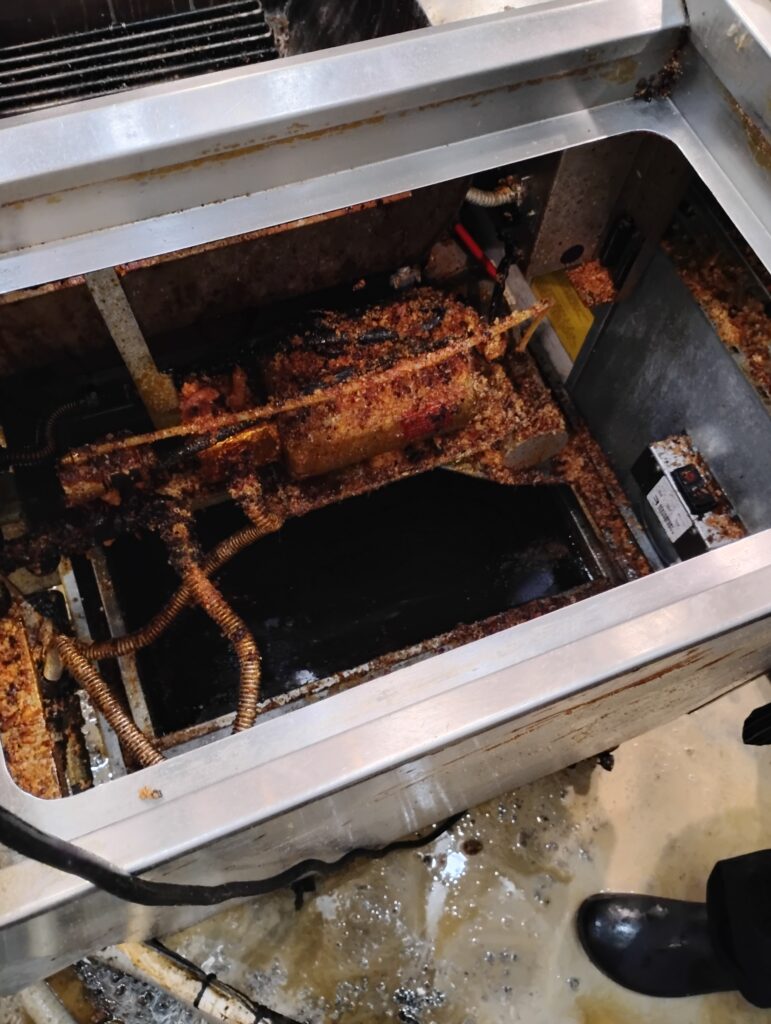
Staff cannot clean hood systems, exhaust ducts, or grease traps. Certified professionals must perform this work and document it to ensure fire code and insurance compliance.
NFPA 96 is the national standard for ventilation and fire safety in commercial kitchens, and most U.S. states enforce it as law.
The 2025 NFPA 96 strengthens requirements for digital records of all hood cleaning and inspection activities. Operators who can’t provide these records could face compliance issues during inspections.
The update also shifted frequency tiers: kitchens that operate 16 hours or more per day now require monthly cleaning regardless of cooking type.
Hood Cleaning Frequency (2025 NFPA 96)
| Cooking Type / Volume | Minimum Cleaning Frequency |
| Solid fuel (wood, charcoal) | Monthly |
| High-volume, 24-hour, wok, or charbroiling | Monthly |
| Moderate-volume standard commercial kitchen | Quarterly |
| Low-volume or seasonal operations | Semi-annually |
Source: NFPA 96 Standard, 2025 edition
Book hood cleaning and grease trap servicing with certified contractors. Record each service in the MCS. Keep the contractor’s service report, including the date, technician’s name, and certification number. This is what protects the operator in a fire insurance claim or health inspection.
For hood and exhaust work, look for certification from the International Kitchen Exhaust Cleaning Association (IKECA). Many states and insurance companies require this certification.
Fines for non-compliance can vary by jurisdiction and may reach $10,000 or more per violation. Insurers may deny fire damage claims for kitchens without current records.
Operators of mobile kitchens, temporary kitchens, and disaster relief solutions must also follow the same NFPA 96 rules.
Scheduling Specialist Deep Cleans: Quarterly, Post-Incident, and Pre-Opening
A complete schedule has two parts: routine tasks that staff perform daily, weekly, and monthly, and specialist deep cleans that need professional equipment and documentation. Both belong in the MCS.
Book a specialist deep clean at these trigger points:
- Quarterly. An Impact Cleaning removes grease behind the line and inside equipment that weekly cleaning doesn’t cover.
- After an incident. If there is a fire, flood, pest problem, equipment failure, or foodborne illness, a Post-Incident Cleaning is necessary before the kitchen can reopen.
- Before a re-inspection. After a failed inspection, you need a Failed Inspection Cleaning to ensure the kitchen can pass the follow-up.
- Shutdown and reopening. Seasonal closures, renovations, and ownership breaks need a Shutdown and Startup Cleaning at both ends.
- After construction. Post-Construction Cleaning addresses dust, sealant residue, and debris before food returns to the kitchen.
- At contract handover. A Contract Transition Cleaning establishes a documented baseline for cleanliness for the new operator.
Log specialist tasks under the contractor’s name. Keep their service report on file with the sign-off. Book contractors 4 to 6 weeks in advance for quarterly cycles and immediately after any triggering event.
Paper Schedule, Digital App, or Both? Choosing the Right Format
A printed and laminated wall-posted chart suits single-location operations with a stable team.
Digital apps like SafetyCulture, Jolt, Connecteam, and FoodDocs provide timestamped sign-offs and remote visibility, making them ideal for franchise operations managers and multi-location operators.
A hybrid approach (paper at the point of work, digital for audit trail) is where most professional kitchens land.
Whatever format you pick, the schedule must produce a signed, dated record. An auto-timestamped digital log is more defensible in an audit than a paper log, where dates can be backdated.
Free Printable Commercial Kitchen Cleaning Schedule Template
The template follows the Master Cleaning Schedule (MCS) format. You can print it, laminate it, and post it in each zone, or you can import it into a digital scheduling tool.
[Download the free printable commercial kitchen cleaning schedule template]
Frequently Asked Questions
What should a commercial kitchen cleaning schedule include?
A commercial kitchen cleaning schedule should include all cleaning tasks organized by frequency: daily, weekly, monthly, or quarterly. It should specify the zone it applies to, the staff role responsible, the assigned day or shift, and a sign-off column.
Specialist tasks, such as hood cleaning, must also appear, along with contractor details and at least one scheduled specialist deep-cleaning service per quarter.
How often should a commercial kitchen be cleaned?
Commercial kitchens require cleaning after each use of food-contact surfaces, daily at shift-end for floors and equipment, weekly for deep cleaning and drain maintenance, and monthly for refrigeration and structural surfaces.
Hood and exhaust systems follow the NFPA 96 schedule: monthly for solid fuel and high-volume operations, quarterly for moderate-volume kitchens, and semi-annually for low-volume or seasonal operations.
What is a Master Cleaning Schedule for a commercial kitchen?
A Master Cleaning Schedule (MCS) is a formal planning document that lists every cleaning task in a commercial kitchen, assigns a frequency, a responsible role, and a specific day to each task, and requires a staff sign-off on completion. The MCS is the document that health inspectors and insurance auditors use to assess whether a kitchen has a cleaning system, not just cleaning habits.
Can I use a Google Sheets or Excel template for a kitchen cleaning schedule?
Yes. Both Google Sheets and Microsoft Excel are great for commercial kitchen cleaning schedules. They’re free, easy to customize, and allow you to track changes.
The limitation is that they are not specifically designed for food safety inspections. They don’t capture photos, mobile sign-offs, or compliance-ready audit logs.
If you need these features, you should use a spreadsheet alongside a digital food safety app like SafetyCulture, Connecteam, or Jolt.
What is the difference between a cleaning checklist and a cleaning schedule?
A cleaning checklist is a list of tasks you need to complete. A cleaning schedule assigns each task a frequency, a responsible role, a specific day, and a sign-off requirement.
You need both. The checklist defines what to clean; the schedule ensures it gets done regularly and can be verified during an inspection.
How do I get my kitchen staff to follow the cleaning schedule?
Post the schedule where people can see it at their workstations. Laminate it for each station, not just in the manager’s office. Assign tasks by role rather than by shift so everyone knows their responsibilities. Train staff on why each task is important, not just how to do it. Check on tasks during service, not only at the end of the shift.