
A missed cleaning task seems like a minor mid-service. But grease buildup, unsanitized surfaces, and unchecked drains are actually the most common reasons commercial kitchens fail health inspections.
They are also the leading cause of kitchen fires. A structured commercial kitchen cleaning checklist is the simplest tool for keeping your kitchen compliant.
This article covers daily, weekly, and monthly cleaning tasks, hood cleaning compliance under NFPA 96, and a free printable template.
Key Takeaways
- Have a step-by-step daily, weekly, and monthly cleaning schedule to keep your kitchen inspection-ready at all times.
- Signed cleaning logs are part of your inspection record. Missing signatures mean missing proof.
- Hood and exhaust cleaning requires certified professionals under NFPA 96. The 2025 update now requires digital documentation of all cleaning activity.
Why a Commercial Kitchen Cleaning Schedule is Non-Negotiable
The Centers for Disease Control and Prevention (CDC) estimates approximately 48 million cases of foodborne illness occur in the U.S. annually, most linked to retail food establishments like restaurants. A proper commercial kitchen cleaning schedule reduces the risk of foodborne illness by ensuring food contact surfaces are properly sanitized.
The Real Cost of Skipping Kitchen Sanitation
The FDA’s Retail Food Risk Factor Study found improper holding temperatures and poor personal hygiene were the two most commonly cited violations in restaurants.
More than that, fire departments respond to an average of 7,410 structure fires in commercial cooking facilities annually, causing approximately $246 million in direct property damage. The primary cause is failure to clean kitchen exhaust systems. Both of these cost a lot of money.
What Health Inspectors Actually Check
Inspectors check food contact surface sanitation, cross-contamination prevention, temperature logs, and chemical storage. They also request HACCP records and signed cleaning logs.
Have a kitchen cleaning schedule and checklist with staff sign-offs for a paper trail to protect your kitchen during audits.
Daily Commercial Kitchen Cleaning Checklist
Each task below should be initialed by the staff member who completed it and reviewed by the kitchen manager at the close of service.
Before and During Service Tasks
- Sanitize food prep surfaces and cutting boards using quaternary ammonium or bleach solution at the dilution ratio on your SDS sheet.
- Sanitize food contact surfaces between uses, especially after handling raw meat, poultry, or seafood.
- Clean and sanitize the steam table before service.
- Verify sanitizer concentration with sanitizer test strips before every service.
- Log refrigerator and freezer temperatures at the start of service. The FDA danger zone is 40°F–140°F / 4°C–60°C. Food held in that range beyond two hours is a violation.
- Confirm color-coded microfiber cloths are in use by zone. Separate cloths for raw protein areas and general surfaces to prevent direct cross-contamination.
End-of-Shift Cleaning Duties
- Clean and degrease stovetops, grills, and fryers.
- Empty, clean, and sanitize all trash receptacles.
- Clean and sanitize all sinks. For three-compartment sink operations, follow the wash, rinse, and sanitize sequence.
- Sweep and mop all floor areas and sanitize floor drains. Unsanitized drains breed bacteria and attract pests.
- Wash and store all dishcloths and mop heads. Damp cloths left overnight are a source of contamination.
- Wipe down the exterior of all appliances.
- Clean walls and backsplashes near cooking equipment.
- Complete and sign the daily cleaning log.
Weekly Deep Cleaning Checklist for Commercial Kitchens
Weekly tasks include addressing grease accumulation, drain buildup, and equipment residue. Schedule this on your slowest service day.
Equipment and Appliance Deep Cleaning
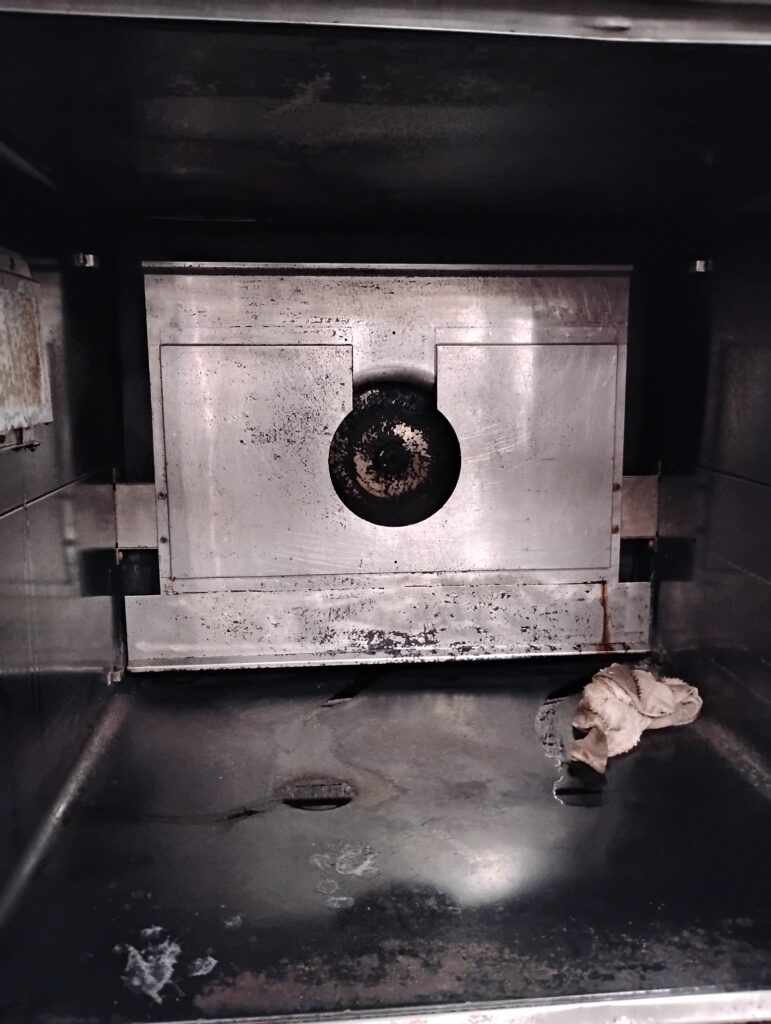
- Deep clean and degrease ovens following the manufacturer’s instructions.
- Clean behind and underneath the entire hot line.
- Clean and sanitize the ice machine exterior. Inspect the interior per the manufacturer’s schedule.
- Deep clean and descale the commercial dishwasher.
- Disassemble, clean, and sanitize the mixer, slicer, and prep equipment per manufacturer instructions.
- Polish stainless steel surfaces. Surface oxidation creates micro-pitting that harbors bacteria.
Floors, Drains, and Hard-to-Reach Areas
- Remove and scrub all floor drain covers. Flush drains with hot water or an enzymatic cleaner.
- Deep clean baseboards and wall-floor junctions.
- Clean under and behind all refrigerators, shelving units, and prep stations.
- Inspect the grease trap or log the date for scheduled professional service.
- Sanitize waste bins and waste storage areas.
Monthly Commercial Kitchen Cleaning Schedule
Walk-in cooler interiors, ceilings above the line, and walls behind equipment all need monthly attention.
Refrigeration and Storage Areas
- Empty and deep clean all walk-in coolers and freezer interiors using food-safe sanitizers.
- Dispose of expired or improperly labeled items. Confirm if FIFO (first in, first out) practices are being followed.
- Inspect door seals and gaskets for cracks or mold.
- Deep-clean the dry storage shelves and check for signs of pest activity or packaging damage.
- Review and update the pest control monitoring log. Confirm your next pest control technician visit is scheduled.
Walls, Ceilings, and Structural Surfaces
- Wash and sanitize all kitchen walls. Prioritize surfaces behind cooking equipment.
- Clean ceiling tiles, light fixtures, and overhead surfaces.
- Inspect and clean ventilation fans.
- Confirm all fire exits and escape routes are unobstructed.
- Polish all stainless steel surfaces.
- Compile, review, and file all equipment temperature logs and cleaning logs for the month.
Hood, Exhaust Vent, and Grease Trap Cleaning: When and How Often
You’re required to have the hood and exhaust cleaned by a certified hood cleaning specialist. NFPA 96 governs ventilation control and fire safety in commercial cooking operations, and the latest update requires digital documentation of all hood cleaning and inspection activities.
| Cooking Type / Volume | Required Cleaning Frequency |
| Solid fuel cooking (wood, charcoal) | Monthly |
| High-volume, 24-hour, wok, or charbroiling operations | Quarterly |
| Moderate-volume standard commercial kitchen | Every 6 months |
| Low-volume or seasonal operations | Annually |
Insurance companies may deny fire damage claims if your kitchen was maintained below NFPA 96 standards. Mobile kitchen operators and disaster relief kitchen managers follow the same NFPA 96 standards as permanent kitchens.
Response Logistics offers mobile kitchen rentals with compliance logistics across deployments.
Cleaning Supplies Every Commercial Kitchen Should Stock
Before cleaning begins, confirm your team has the right tools on hand. Store all of these in a designated, clearly labeled cabinet separated from food storage and food prep areas.
- Chemicals & sanitizers: Commercial-grade degreaser, quaternary ammonium or bleach solution (dilution per your SDS sheet), enzymatic drain cleaner, and sanitizer test strips
- Tools & equipment: Color-coded microfiber cloths by zone, food-contact-rated scrub brushes and scouring pads, squeegee and floor scrubber, mop and mop bucket, steam cleaner, and PPE including chemical-resistant gloves, goggles, and apron
- Documentation: SDS/MSDS binder for every chemical on-site (OSHA requirement) and a daily cleaning log with staff sign-off columns printed or digital via SafetyCulture or Connecteam
How to Build a Culture of Accountability Around Your Cleaning Checklist
A checklist only works if the roles are assigned, the staff understand and do their job properly, and someone really verifies completion.
To build a culture of accountability:
- Assign tasks by role. The kitchen manager owns sign-off and compliance. The kitchen porter owns floors and drains. Line cooks own station equipment.
- Post the checklist at the point of work. Place a laminated copy at each station for easy monitoring.
- Rotate cleaning responsibilities. Cross-train your team so they know how to clean each zone, especially when your staff goes on leave.
- Use digital logging for timestamped records. Tools like Connecteam, SafetyCulture, and Jolt let franchise operations managers and institutional kitchen supervisors verify task completion across multiple sites without being physically present. A timestamped photo log is also a far more defensible audit trail than a paper sheet with end-of-day signatures.
Resetting Your Cleaning Program: When to Rebuild the System from Scratch
Staff change, habits slip, and the checklist that worked in month one may actually be ignored by month six, especially if you’re not keen on it. In such cases, you need a system reset. Do so if you meet the following triggers:
- New year or new management
- Failed health inspection
- Post-incident event (fire, flood, pest infestation, equipment failure)
- Ownership or management change
- Post-construction/new opening
- Seasonal reopening after a shutdown
To reset your cleaning program, audit the current logs and identify which tasks are being skipped. Retrain staff on the why behind each task. Then, rebuild role assignments so every task has a named responsible party.
You may also want to schedule a professional deep clean to start from scratch before you do all the resetting.
Free Printable Commercial Kitchen Cleaning Checklist Template
The template below covers daily, weekly, and monthly tasks with a sign-off column for staff initials and a manager review column. Print it, laminate it, and post it at each station. This works for any kitchen format, including restaurants, mobile kitchens, school cafeterias, institutional kitchens, and food trucks.
[DOWNLOAD FREE PRINTABLE KITCHEN CLEANING CHECKLIST TEMPLATE HERE]
Frequently Asked Questions
How often should a commercial kitchen be deep cleaned?
Commercial kitchens require daily, weekly, and monthly cleaning. Daily covers surfaces, equipment, and floors. Weekly covers drains, appliances, and behind-the-line grease. Monthly covers refrigeration units and structural surfaces.
What goes on a commercial kitchen cleaning checklist?
A commercial kitchen cleaning checklist comes with daily, weekly, and monthly tasks, each with employee sign-offs. Daily tasks include food-contact surfaces, equipment, and floors. Weekly tasks cover drains, appliances, and behind-the-line grease. Monthly tasks cover refrigeration interiors, walls, and ventilation.
Who is responsible for cleaning in a commercial kitchen?
Responsibility varies by role. The kitchen manager owns sign-off and documentation. The kitchen porter/dishwasher is responsible for the floors and drains. Line cooks take care of station equipment and food contact surfaces. Hood cleaning and grease trap servicing must be performed by certified professionals in accordance with NFPA 96.
What cleaning products are safe for a commercial kitchen?
The standard sanitizers for commerical kitchens are quaternary ammonium and diluted bleach solution. For cooking equipment, use a commercial-grade degreaser. For drains, use enzymatic cleaners.
What is the difference between cleaning and sanitizing in a commercial kitchen?
Cleaning removes visible grease and debris. Sanitizing reduces bacteria and other pathogens to safe levels. You need to perform both steps on food contact surfaces, in that order.
What happens if a commercial kitchen fails a health inspection?
You may get a written notice of violation and a mandatory return inspection. Fines vary by jurisdiction and violation. If you have serious or repeated violations, that can result in temporary closure and/or permit suspension.
A signed cleaning checklist with documented compliance helps you reduce the risk of violations and gives you a defensible record if a dispute arises.